


June Whiskies of the Month: World Environment Day
June 5th marks World Environment Day. This year’s focus is climate change and what can be achieved to address rising temperatures, ecosystem survival and other signals of climate change. With Scotch whisky crafted from just three natural ingredients, the industry is determined to preserve the country’s landscapes and ecosystems. This month’s selection highlights the distilleries taking positive steps towards sustainability and environmental responsibility.


Lowlands - Eden Mill Bourbon
Eden Mill Distillery is fully operational with electricity from renewable resources; this includes being primarily powered by the University of St Andrew’s solar panels. The distillation effluent will be upcycled to clean water. In 2016, it won the Sustainable Development Award at the Scottish Green Energy Awards.
During the fermentation process, CO₂ is naturally produced. Eden Mill captures this and is collaborating with private sector companies to convert it into fuel. Another relevant partnership is that with Biotech MiAlgae. They aim to repurpose whisky by-product to grow microalgae as a sustainable source of Omega-3s, eliminating the need for fish while supplying the same nutrients.
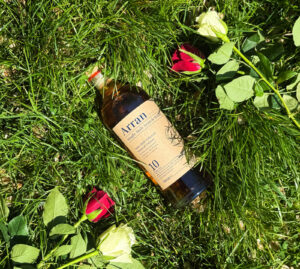
Highlands - Arran 10 year old
Isle of Arran Distillers’ five sustainability priorities: Water, Land, Waste, Emissions and Community.
- Water: They’ve reduced their water usage for cooling by implementing cooling towers.
- Land: Arran Distillery introduced beehives which have produced award-winning Arran honey. They also donate to a community farming project and provide financial support for a major peatland restoration initiative at Dougarie Estate on Arran.
- Waste: The packaging bottles use 8% less glass than the previous design. The stoppers are made from natural wood, with the cork sourced from accredited forests. Gift tubes are produced from 92% recycled paper and 100% recycled tin, with the option for customers to opt out entirely. Tamper-proof closures are made from recyclable PET (Polyethylene Terephthalate) and shipping cases are constructed from 100% recycled material.
- Emissions: Most lighting is provided by LED lights, which use 50-80% less energy than incandescent bulbs, helping to reduce the distillery’s carbon footprint.
- Community: Arran Distillery are members of the Green Island Project which aims for businesses on the island to improve their carbon footprint. Their goal is to be net zero by 2030.
When it comes to energy sources, the distillery offices are heated by an air heating system instead of gas and electric vehicle charging points are available for distillery visitors. They are also exploring the installation of solar panels and wind turbines, along with introducing an e-bike scheme for staff.

Speyside - Aberlour 12 year old
Pernod Ricard is part of The River Within initiative with three Scottish river trusts. They’re restoring woodland to provide shade and to reduce the temperature. The project includes fencing along rivers to prevent animals from grazing and damaging vegetation. This allows rivers to return to their natural bends, slowing the flow and creating better conditions for fauna to thrive. Additionally, they are removing obsolete weirs to allow fish to swim upstream and reproduce.
Chivas aims to be carbon neutral by 2026. The packaging of Aberlour is a depiction of its connection to nature with an oak tree over water. The bottle weighs 16% less than it previously did, making shipping more efficient.
In 2022, Chivas invested £88 million between Aberlour and Miltonduff to implement heat recovery technologies, such as Mechanical Vapour Recompression and Thermo Vapour Recompression, capturing and recycling heat from the distillation process. As a result, all malt distilleries from Chivas have some form of heat recovery system.
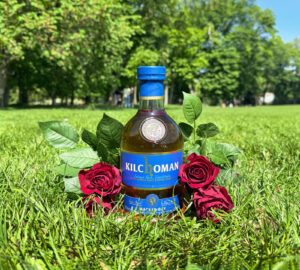
Islay - Kilchoman Machir Bay
Kilchoman’s production approach is farm to bottle. It is a farm distillery that grows its own barley, operates its own floor maltings and sources water from a spring close by. They focus on the use of local ingredients, which results in a celebration of Islay’s flavours while reducing the emissions and impact of transportation from the mainland to Islay. The distillery is situated next to the Gulf Stream, which naturally helps regulate the temperature required to grow barley.
Kilchoman also reuses whisky by-product (draff), to feed a herd of Angus cattle located in the west of the distillery’s farm. On the south, the hill is grazed by their blackface sheep, maintaining balance between flora and fauna. From the 2,300 acres of land, 17.3% is used for the annual barley crop, which is sown after 50,000 migratory geese have left the island.
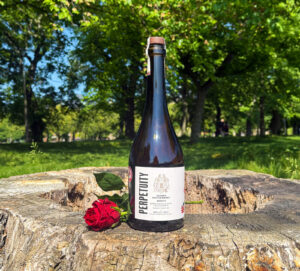
Blend - Perpetuity Batch 2
Port of Leith is a B Corp Certified company, meaning it meets high standards of social and environmental performance. It builds partnerships with local farmers and businesses that share its commitment to sustainability, working with barley and malting farms based in Edinburgh to reduce transportation distances and associated emissions.
The distillery is designed vertically and holds the title of the world’s tallest distillery at 40 metres, spread across nine storeys. Its production process is stacked to take advantage of gravity, allowing materials to move naturally between stages. For example, wort is transferred down to the fermenters using gravity, helping to lower overall energy use.

Luxury: Highland Park 18 year old
Highland Park works in partnership with organisations such as the RSPB (Royal Society for the Protection of Birds) and NatureScot to develop conservation strategies that help preserve Orkney’s unique natural habitat, where the distillery is based.
In addition, it collaborates with Heriot-Watt University’s Orkney campus and Project Seagrass to research, catalogue and map the island’s biodiversity, with a particular focus on its ‘celebrated seagrass meadows.’
Furthermore, the distillery extracts peat locally and has received the Responsibly Managed Peatlands Certification, which is awarded to organisations that actively minimise negative environmental impact. Building on this commitment, Highland Park also worked with The Scotch Whisky Association to develop the Framework for Best Practice for Peat Extraction. Alongside these efforts, the distillery has carried out a number of peatland restoration pilot initiatives. Through these combined actions, Highland Park is supporting long-term environmental protection while working towards its goal of reaching net zero by 2045.
At The Scotch Whisky Experience, we have a commitment to sustainability and are assessed under the Green Tourism scheme, the leading sustainable tourism certification scheme in the UK. This covers People (health & wellbeing, community, equality and diversity), Place (experiences, food & drink and biodiversity) and Planet (energy, waste, water, carbon and chemicals). As a result, we are delighted to hold a Gold award and are working hard to make positive actions every day to do more across all of these goals.