

January Whiskies of the Month - Whisky Firsts
As January is the first month of the year, we are celebrating ‘whisky firsts’ from six different brands across the Scotch whisky industry.
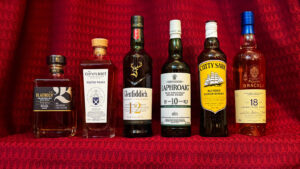

Lowland - Bladnoch Vinaya
ABV: 46.7%
Bladnoch is a Lowland distillery founded in 1817 by John and Thomas McClelland. It is not only Scotland’s most southernly distillery but is also the oldest privately owned Scotch whisky distillery in the world.
Bladnoch is located near Wigtown, Dumfries and Galloway on the banks of the River Bladnoch. For nearly a century, the distillery was passed down through successive generations of the McClelland family who grew and modernised the company. At its peak, the distillery had six washbacks and produced approximately 230,000 litres of alcohol annually which cemented its status as the “Queen of the Lowlands.”
The distillery first: Scotch whisky’s global influence is apparent in its ability to adapt to diverse tastes and markets. Its impact reaches far beyond Scotland, notably Japan where Masataka Taketsuru (The Father of Japanese Whisky), travelled to Scotland in 1918 to master the art of distilling. This exchange also marked the beginning of foreign ownership of Scotch whisky distilleries.
Since then, distilleries have found themselves being owned by Italian, French, American and English companies and in 2015, Bladnoch saw itself become the first Scotch whisky distillery to be owned by an Australian. David Prior, an Australian entrepreneur, had a strong passion for whisky and a desire to restore the heart and soul of the local community. This led him to buying this over 200-year-old distillery.

Highland - Glenturret Triple Wood
ABV: 45%
Glenturret is a Highland distillery located around 2 miles from the town of Crieff. Founded in 1763, it claims to be the oldest whisky distillery in Scotland. In 2024, Glenturret announced they would be removing peat from their production starting in 2025, to only releasing non-peated expressions.
Story of Towser the cat: Towser, a long-haired tortoiseshell cat at Glenturret (1963–1987), was a Guinness-recognised record holder credited with an estimated 28,899 mice. Her kills were monitored and statistically verified, and she was later honoured with a bronze statue, BBC Blue Peter coverage, and paw prints on Fairlie’s liqueur labels. She was succeeded by Dylan and Brooke, and today, the distillery employs Glen and Turret as its resident mousers.
The distillery first: The first and only distillery in Europe to have a two Michelin Star restaurant on site, called ‘Lalique’. The restaurant opened in 2021, pioneering the concept of combining fine dining with whisky heritage. After only seven months of opening, it received its first Michelin Star, and on 5th February 2024, it welcomed its second one!

Speyside - Glenfiddich 12 Year Old
ABV: 40%
Glenfiddich is a Speyside whisky located in the Scottish Highlands, halfway between Inverness and Aberdeen.
In the summer of 1886, William Grant and his seven sons set out on their lifelong goal to create a whisky distillery. Over the next year, they built it together, stone by stone and by 1887, their distillery was complete. Their first drop of spirit arrived on Christmas Day of that very year. They named it ‘Glenfiddich’, translated from Scottish Gaelic, ‘Valley of the Deer’.
Glenfiddich remains in the hands of the William Grant family today, which makes it one of the few to remain with the same owners since its beginning.
It has since grown to become the world’s most awarded Scotch whisky.
The distillery first: Glenfiddich was the first distillery in Scotland to open a visitor centre and run commercial tours. This allowed them to market their whisky to a more widespread audience and help boost their name. Glenfiddich was also the first scotch whisky to market itself, marking a huge milestone in the scotch whisky industry.
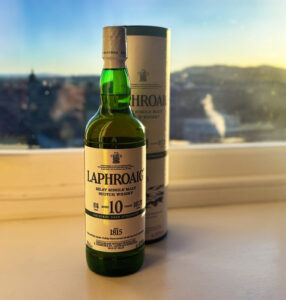
Islay - Laphroaig 10 Year Old
ABV: 40%
Laphroaig is an Islay whisky located on the south side of the west coast Scottish island, a few miles away from the nearest town of Port Ellen.
Laphroaig was founded back in 1815 by brothers Donald and Alexander Johnston. They had originally leased 1000 acres of land to the laird to raise his cattle, for which they grew barley to feed them in the winter months, and with the excess barley they decided to produce whisky. Soon after, the whisky had become more profitable than farming, and by the end of 1815, Laphroaig was officially born.
The distillery first: Bessie Williamson, a girl from Glasgow, sailed over to Islay for an intended 3-month stay to work at the Laphroaig distillery in 1935. However, her duration on Islay and at Laphroaig, turned into a lifetime.
Ian Hunter (the owner of Laphroaig at the time), saw the passion and determination she possessed when it came to Laphroaig, and over the years, passed on many of the distillery’s secrets to her. After Ian’s passing in 1954, Bessie took the reins and became the first woman of the 20th century to be the owner of a Scotch whisky distillery. She became a pioneer for women in the industry and transformed Laphroaig forever by bringing Ian Hunter’s ideas of maturating their spirit in ex-bourbon barrels, into practice. This innovation is still at the heart of their process today.
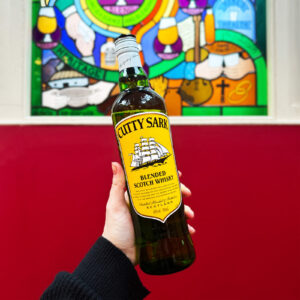
Blend - Cutty Sark Original
ABV: 40%
Cutty Sark is a blended Scotch whisky using different single malts from around Scotland to create its smooth fruity flavour. Highland Park, Macallan, Glenrothes and Bunnahabhain are all mixed together with grain whiskies from North British and Invergordon.
The idea of Cutty Sark was first thought up on 23rd March 1923 in London, when Francis Berry and Hugh Rudd (the famous wine makers ‘Berry Bros and Rudd’), met with Scottish artist, James McBey for lunch. During this time, they quickly began talking about whisky and before long, plans were in motion to create a blended Scotch whisky that could be exported into the USA. This was in the midst of the USA prohibition!
McBey, who was an enthusiastic sailor, designed the label for the new whisky. Since the whisky was named after the famous three-mast sea clipper, the vessel became an integral centrepiece of the design. The label was intended to be a cream colour, but a printing error turned it yellow, a distinctive feature that remains unchanged to this day.
After the USA prohibition had ended, sales of Cutty Sark rocketed from around 7000 cases in 1934, to almost 90’000 cases in 1936.
The whisky first: In 1963, the youngest of the USA’s first seven astronauts, Gordon Cooper, smuggled a 5cl bottle of Cutty Sark with him onto the Mercury 9 Mission, making it the first ever Scotch whisky to go into space.

Royal Brackla 18 Year Old
ABV: 46%
The Royal Brackla distillery is found in the Highlands, on the lush farmland of Cawdor Estate. The distillery prides themselves on making bright and fruity whiskies, with every expression being finished in first-fill sherry casks. Captain William Fraser founded the Royal Brackla in 1812 and by 1835, he had earned the first Royal Warrant in Scotch history.
Captain William Fraser was born in Brackla in 1767. At the age of 16, he enlisted in the army and worked his way through the ranks to Captaincy. At 31, he retired and returned to his home on the farm of Cawdor Estate. Fraser was concerned that the barley being grown on his farmland was being used by illicit whisky distillers.
However, the passing of the Small Stills Act had encouraged local landowners to create their own small, licensed distilleries. Inspired by this, Fraser built Brackla Distillery and used clever marketing to propel Brackla whisky into the market. The Captain knew there was little demand for his whisky with the locals, so he appointed agents in Aberdeen, Inverness and other Scottish cities to take orders from dealers and families. The orders would be shipped to their cities from Inverness twice a week – an early example of direct mail order business.
The whisky first: How Fraser secured the first Royal Warrant for Scotch whisky remains a little of a mystery. Perhaps it was his military connections? Or, through the goods offices of his friends from London? Nonetheless, Fraser was granted the privilege to use the Royal Arms in 1835 by King William IV. The distillery was immediately renamed Royal Brackla and was to be referred to as ‘The King’s Own Whisky’. This warrant has been upheld by every monarch since, and reflects Captain William Fraser as a whisky royal himself!